

Understanding waste classifications is essential for compliance in the waste management industry. This guide explains the structure of European Waste Catalogue (EWC) codes, the different entry types, Hazardous Properties (HP) codes, and Recovery and Disposal (RD) codes as they appear in the Dashboard waste thesaurus.
EWC code structure
EWC codes use a hierarchical numbering system with three levels:
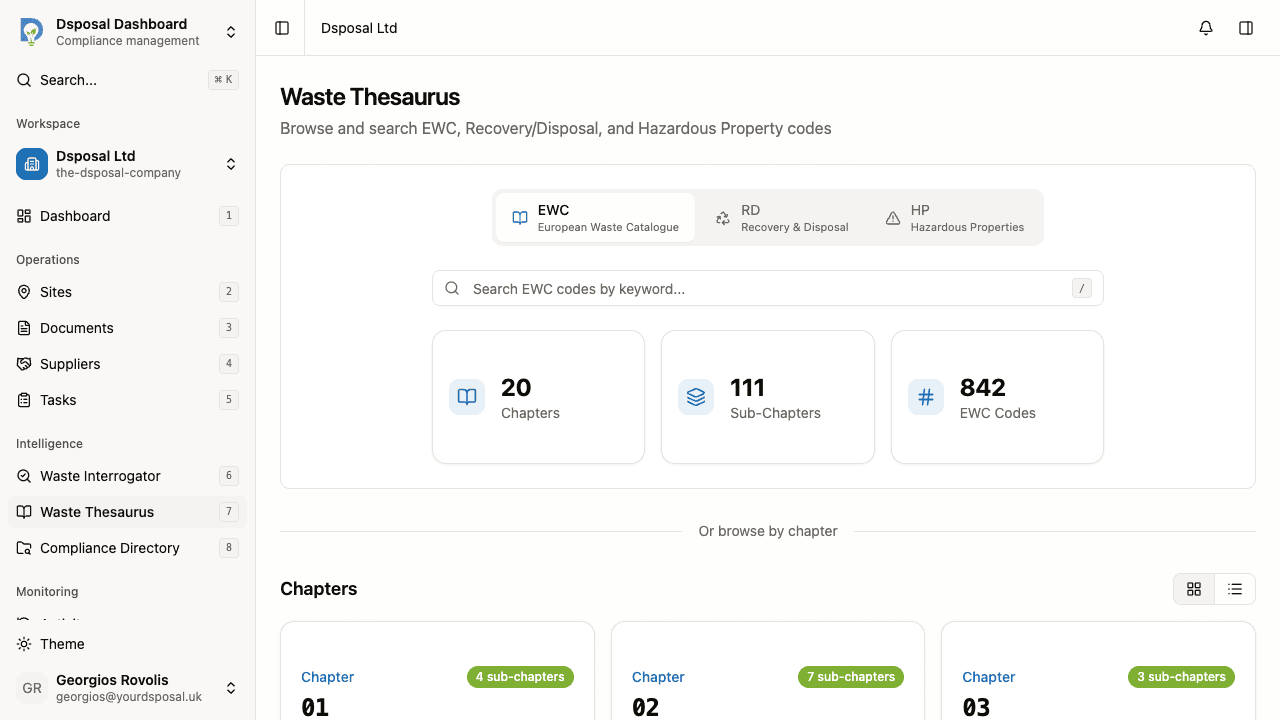
Chapters (2-digit codes)
Chapters are the broadest category, grouping waste by its source or the industrial process that produced it. For example:
- 01 — Wastes resulting from exploration, mining, quarrying, and physical and chemical treatment of minerals
- 15 — Waste packaging; absorbents, wiping cloths, filter materials and protective clothing not otherwise specified
- 20 — Municipal wastes, including separately collected fractions
Sub-chapters (4-digit codes)
Sub-chapters narrow down the waste source within a chapter. For example, within Chapter 17 (Construction and demolition wastes):
- 17 01 — Concrete, bricks, tiles and ceramics
- 17 02 — Wood, glass and plastic
- 17 03 — Bituminous mixtures, coal tar and tarred products
Codes (6-digit codes)
Individual 6-digit codes identify specific waste types. For example:
- 17 01 01 — Concrete
- 17 01 02 — Bricks
- 17 01 03 — Tiles and ceramics
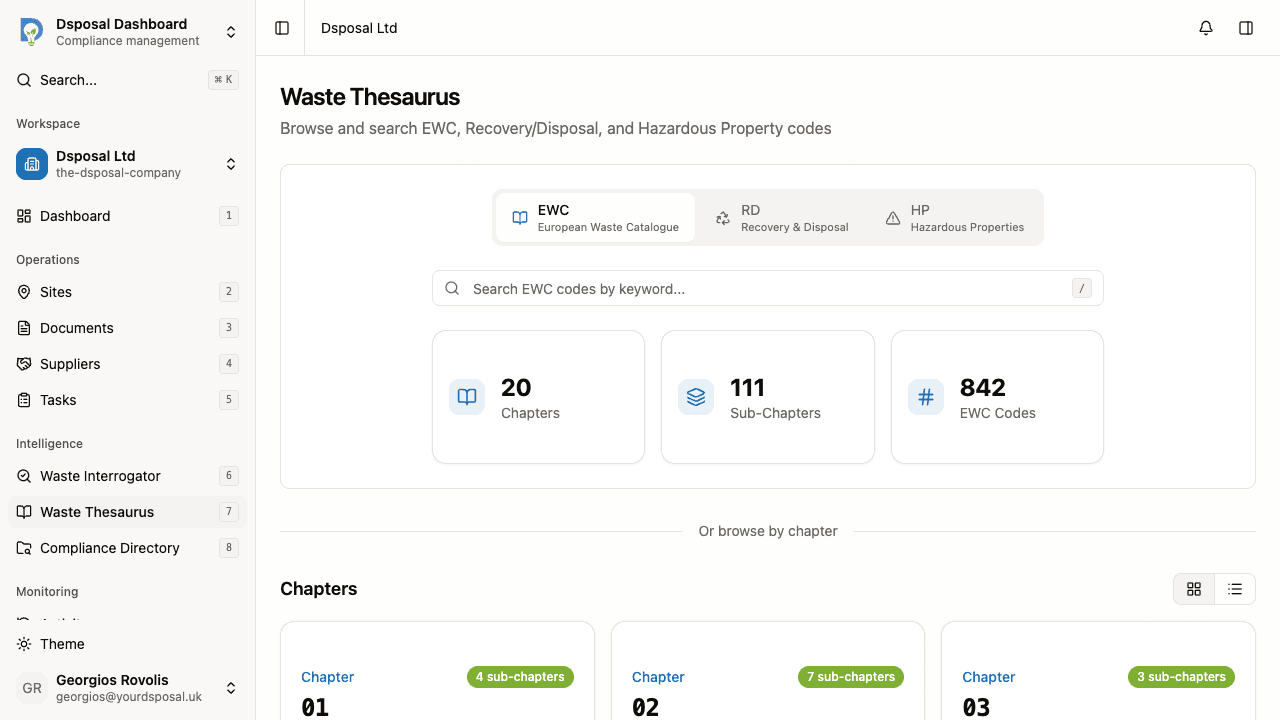
In the waste thesaurus, breadcrumb navigation at the top of every code detail page shows the full hierarchy path, making it easy to navigate between levels.
EWC chapter overview
The European Waste Catalogue contains 20 chapters. Chapters 01 to 12 and 17 to 20 are based on the industrial source of the waste. Chapters 13 to 15 are based on the type of waste material. Chapter 16 covers wastes not otherwise specified.
| Chapter | Description | |---------|-------------| | 01 | Wastes from exploration, mining, quarrying, and physical/chemical treatment of minerals | | 02 | Wastes from agriculture, horticulture, aquaculture, forestry, hunting, and fishing | | 03 | Wastes from wood processing and the production of panels, furniture, pulp, paper, and cardboard | | 04 | Wastes from the leather, fur, and textile industries | | 05 | Wastes from petroleum refining, natural gas purification, and pyrolytic treatment of coal | | 06 | Wastes from inorganic chemical processes | | 07 | Wastes from organic chemical processes | | 08 | Wastes from the manufacture, formulation, supply, and use of coatings, adhesives, sealants, and printing inks | | 09 | Wastes from the photographic industry | | 10 | Wastes from thermal processes | | 11 | Wastes from chemical surface treatment and coating of metals; non-ferrous hydrometallurgy | | 12 | Wastes from shaping and physical/mechanical surface treatment of metals and plastics | | 13 | Oil wastes and wastes of liquid fuels (except edible oils) | | 14 | Waste organic solvents, refrigerants, and propellants | | 15 | Waste packaging; absorbents, wiping cloths, filter materials, and protective clothing | | 16 | Wastes not otherwise specified in the list | | 17 | Construction and demolition wastes (including excavated soil from contaminated sites) | | 18 | Wastes from human or animal healthcare and/or related research | | 19 | Wastes from waste management facilities, off-site wastewater treatment plants, and the water industry | | 20 | Municipal wastes including separately collected fractions |
Entry types explained
Every EWC code has an entry type that determines whether the waste it describes is classified as hazardous. The waste thesaurus displays these as coloured badges on code detail pages.
Absolute hazardous entries
Waste covered by absolute hazardous entries is always classified as hazardous, regardless of its composition or concentration of dangerous substances. These entries are clearly marked and require hazardous waste handling procedures.
Absolute non-hazardous entries
These entries describe waste that is never hazardous. The waste can be handled using standard (non-hazardous) waste management procedures.
Mirror entries
Mirror entries come in pairs — one hazardous and one non-hazardous — for the same type of waste. Whether the waste is hazardous depends on its actual composition and the concentration of dangerous substances it contains.
Hazardous Properties (HP codes)
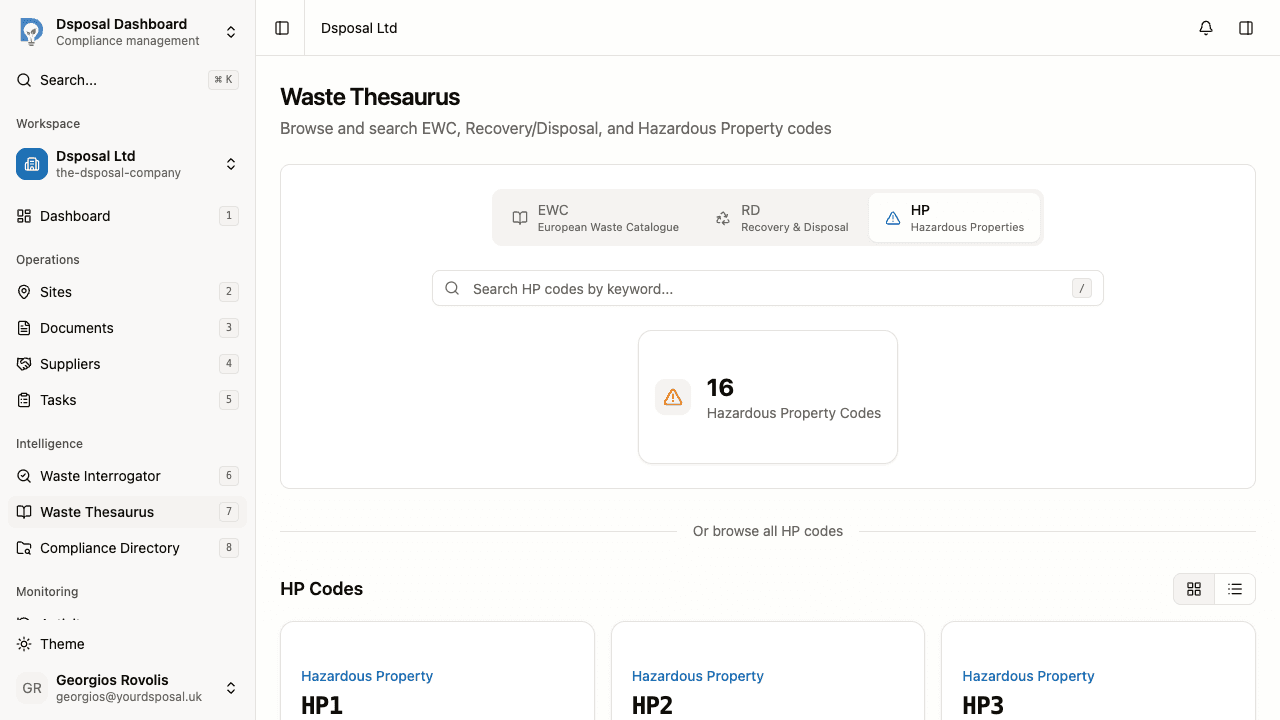
HP codes describe the specific hazardous properties that waste may exhibit. There are 15 hazardous properties defined in waste legislation:
| Code | Property | |------|----------| | HP1 | Explosive | | HP2 | Oxidising | | HP3 | Flammable | | HP4 | Irritant | | HP5 | Specific target organ toxicity / Aspiration toxicity | | HP6 | Acute toxicity | | HP7 | Carcinogenic | | HP8 | Corrosive | | HP9 | Infectious | | HP10 | Toxic for reproduction | | HP11 | Mutagenic | | HP12 | Release of an acute toxic gas | | HP13 | Sensitising | | HP14 | Ecotoxic | | HP15 | Capable of yielding another substance that possesses any of the above properties |
In the waste thesaurus, each HP code has its own detail page with a full description of the hazardous property and its implications.
Recovery and Disposal codes (RD codes)
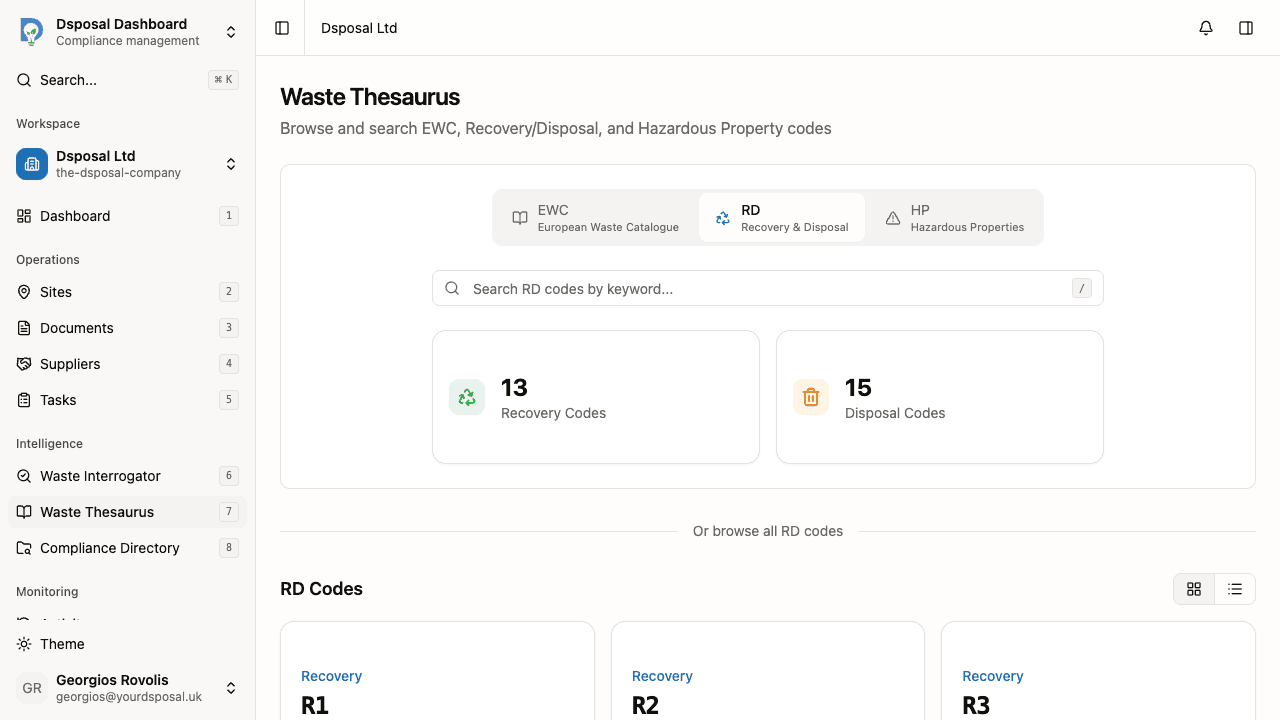
RD codes describe the operations used to manage waste. They are split into two categories:
R codes (Recovery operations)
R codes describe operations that recover value from waste, including:
- R1 — Use principally as a fuel or other means to generate energy
- R2 — Solvent reclamation/regeneration
- R3 — Recycling/reclamation of organic substances
- R4 — Recycling/reclamation of metals and metal compounds
- R5 — Recycling/reclamation of other inorganic materials
D codes (Disposal operations)
D codes describe operations that dispose of waste without recovering value:
- D1 — Deposit into or onto land (e.g. landfill)
- D2 — Land treatment
- D5 — Specially engineered landfill
- D10 — Incineration on land
Classifying waste: a worked example
To see how waste classification works in practice, consider the example of used cutting fluids from a metalworking operation.
Identify the waste source
The waste is a cutting fluid used in metal machining. It comes from a metalworking process, which points you towards Chapter 12 — wastes from shaping and physical/mechanical surface treatment of metals and plastics.
Find the sub-chapter
Within Chapter 12, look for the sub-chapter that matches your process. 12 01 covers wastes from shaping and physical/mechanical surface treatment of metals and plastics.
Identify the specific code
Browse the individual codes under 12 01. Code 12 01 09* is described as "machining emulsions and solutions free of halogens." The asterisk (*) indicates this is a hazardous waste entry.
Check the entry type
In the waste thesaurus, 12 01 09* is classified as an absolute hazardous entry. This means the waste is always hazardous regardless of its exact composition. You must follow hazardous waste procedures — including using a hazardous waste consignment note rather than a standard waste transfer note.
Reading a code detail page
When you view an individual EWC code in the waste thesaurus, the detail page includes:
- Code number and description — the full title of the waste type
- Copy button — copies the code number to your clipboard
- Classification card — shows the entry type badge and the code's position in the chapter/sub-chapter hierarchy
- Tags — any additional classification tags applied to the code
- Search bar — search for other codes without leaving the page (or press /)
- Breadcrumb navigation — links to navigate up through the hierarchy
What to do next
- Browse the waste thesaurus to explore codes hands-on
- Use the waste interrogator to analyse your sites' waste disposal data
Keep moving
Next steps
Explore further